[A few days ago, I have been interviewed by one of my students at Vilnius University. The questions were very perceptive, touching upon my overlapping but often competing research, teaching, and poetic writing commitments. I report here part of the interview – for the full text, click on the Vilnius University (–> Faculty of Philology –> English Academy) website.]
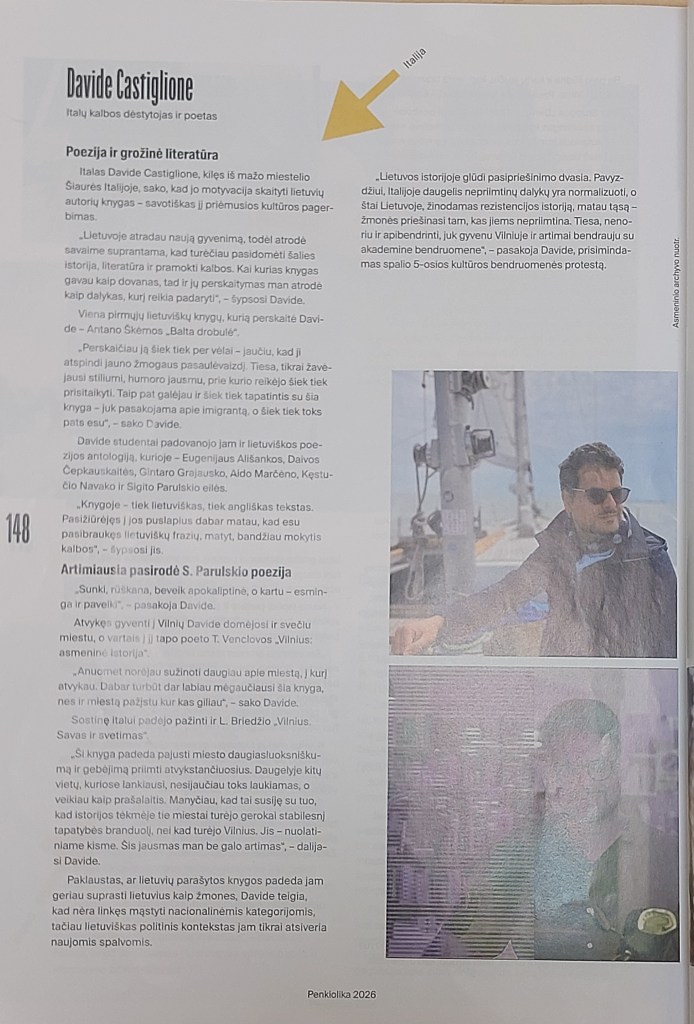
Professor Castiglione, a researcher in the field of English stylistics and an Italian poet, shares his secrets of balancing between multiple projects and uncovers the sources of poetic inspiration: ‘Life itself, and especially its various crises and contemporary loneliness, is the most fruitful source’.
Dr Castiglione, the versatility of your professional interests is truly impressive. What are the biggest challenges in balancing your research and teaching activities with writing poetry?
Excellent question! And one I’ve often asked myself too. Doing research, teaching and writing poetry are three activities that, while rewarding in different ways, are attention-intensive and occasionally even mentally draining. Each of them requires time and serious dedication to be carried out at a satisfactory level – that is, at a level at least on a par with one’s past performance and not too far from one’s self-assessed potential. Translated into everyday lived experience, this means that two of these three areas tend to be temporarily sidelined. For example, my teaching load is much lighter in autumn than in spring, which allows me to dedicate more time to poetry writing OR research from September to January: over the last three years (2022-2025) I have experienced a prolonged creative outburst resulting in a new poetry collection that is now almost ready. This was not only a writing project, but an existential exploration of my own past and of a given historical period, roughly from the 90s to the early 00s: a memoir of sorts in which I have stayed constantly in touch with my former self and with the environment that shaped it. Regrettably, this has left me with little energy or time for academic research, which has again become my top priority (after a post-doc in 2020-2022): in August this year, I submitted a book proposal, and in 2026 I should have two academic articles coming out, which were written slowly and laboriously in 2023 and 2024. Once the poetry demon is satiated, then, the research demon is back to reclaim attention. Teaching is intensive as a performance – after all, you are leading various classes and have a responsibility in front of your students: to be knowledgeable, organised, engaging, fair. From February to May there’s almost only teaching. Luckily, preparing myself now requires less time than it used to, since I already have plenty of teaching materials I reuse every year – although, in fairness, they still require constant updating: I do not know if I am a perfectionist, but I feel less motivated when using materials that no longer satisfy me. All in all, it’s a complicated coexistence, but so far it has worked out reasonably well.
Some projects might be more rewarding and/or exciting than others. Do you have a favorite one?
I have been lucky to work on projects entirely conceived and planned by myself, be they poetic, academic, or more broadly cultural. I find all of them equally exciting, each in its own right, but of course I tend to feel more strongly about the latest ones (it is only fair to say that, while I am good at starting new things, concluding them is not my forte…). For example, now there’s this new academic monograph to write, described in the book proposal mentioned before, and which itself stems from my revised stylistics course: proof of how developing new teaching materials and testing them in the classroom can provide the impetus for new research. The excitement lies in the discovery or creation process itself; the reward, however, partly hinges on how these projects will eventually be received by their intended audiences: poetic readerships, academic colleagues, institutions, the broader public. Speaking of outreach and volunteering, on 27 November I am also starting an eight-week online creative writing course for students in Gaza. This opportunity came about thanks to the support of colleagues at the University of Northumbria, UK, who already have experience in collaborating with professors and students at the Islamic University of Gaza. It is an act of solidarity made all the more urgent by the fact that education in Gaza has been systematically destroyed.
What motivates you to write poetry? Where do you find inspiration?
Introspection, memory, and direct observation are the cognitive paths I walk most often when writing poetry. These paths are all rooted in silence and solitude, so inspiration often thrives in this kind of ambience (no wonder I wrote a lot during the pandemic!). Life itself, and especially its various crises and contemporary loneliness, is the most fruitful source. In my third collection, Doveri di una costruzione (Duties of a Construction), there are poems about break-ups, miscommunication, mundane epiphanies, a dog in an oncology ward, toxic masculinity, the relationship between urban places and the lives they shape, even an ekphrastic attempt at capturing live electronic concerts with their technological hymns to chaos and their primordial vibes. In short, anything that interrogates me at a certain point in life but that, unlike academic research, elicits a synthetic rather than an analytic response. Just like fiction, poetry is a kind of knowledge that is accessible via intuition and embodied experience, rather than via the careful argumentation and verifiability at the core of academic research. My ultimate motivation, however, is simply to create something that I can enjoy as a reader myself: verbal constructions with a distinctive style and a sensuous rhythm, capable of inviting (and withstanding) several re-readings. A place for someone to pause and learn or marvel, just like the church depicted in a memorable poem by Philip Larkin. [continue here]
 DAVIDE CASTIGLIONE