Categoria: News/segnalazioni

  • 32# Versioni da Philip Larkin su L’Ulisse

    Sull’ultimo, ricchissimo numero della rivista L’Ulisse (no. 27), dedicato al tema monografico “Poesia, fotografia e post-fotografia”, e curato da Francesco Deotto, Stefano Salvi e Italo Testa, sono apparse anche sette mie versioni da Philip Larkin (pp. 414-421), e più precisamente dal suo “vero” esordio,The Less Deceived (1955). Nello stesso numero della rivista, scopro con piacere che Michela Davo ha dedicato un puntuale saggio (pp. 160-170) a Lines on a Young Lady’s Photograph Album, che apre il succitato libro. In questo saggio, in linea con l’impianto monografico del numero incentrato sul rapporto fra poesia e fotografia, la studiosa esamina l’interrelazione e le discrasie fra arte poetica e arte fotografica, restando vicina ai segnali stilistici di Larkin e ponendosi in dialogo con interpretazioni precedenti e la testimonianza della stessa young lady dedicataria della poesia. Subito dopo le mie traduzioni (pp. 421-436), fra l’altro, troverete anche le versioni del mio sodale Roberto Minardi dal poeta honduregno Roberto Sosa, mai prima tradotto in italiano se non dallo stesso Minardi, se non mi sbaglio.

    Nel 2024 ho tradotto Larkin con discreta costanza – circa una ventina di testi, tutti da The Less Deceived, con l’auspicio di tradurre l’intero libro (qui potete leggere alcune mie note traduttologiche a riguardo). Nel 2025 mi sono un po’ fermato, complice forse la consapevolezza che a breve uscirà addirittura un Meridiano Mondadori sul poeta inglese – ottima notizia di per sé, ma anche dolceamara, per quanto riguarda ostacoli legati ai diritti d’autore nella circolazione di versioni alternative a quella che sarà la versione ufficiale.

    Proprio alla luce di ciò, tuttavia, mi fa molto piacere che circa un terzo di questo mio piccolo corpus abbia iniziato a circolare su una rivista free access ma al tempo stesso di ottimo livello accademico. La mia speranza è quella di aver preservato qualcosa della particolarissima tonalità del dettato larkiniano. Lascio a voi il giudizio sulla bontà o meno di questo mio sforzo. Qui sotto, un primo assaggio – il resto, appunto, lo troverete direttamente sul pdf della rivista ai numeri di pagina indicati.

    Absences

    Rain patters on a sea that tilts and sighs.
    Fast-running floors, collapsing into hollows,
    Tower suddenly, spray-haired. Contrariwise,
    A wave drops like a wall: another follows,
    Wilting and scrambling, tirelessly at play
    Where there are no ships and no shallows.


    Above the sea, the yet more shoreless day,
    Riddled by wind, trails lit-up galleries:
    They shift to giant ribbing, sift away.


    Such attics cleared of me! Such absences!

    Assenze


    La pioggia pizzica un mare che stride e s’inarca.
    Pavimenti precipitosi collassano in vuoti,
    svettano improvvisi, brizzolati. In contromarcia
    crolla un’onda come un muro: ne arriva un’altra,
    avvizzisce poi balza, gioca inesausta nei moti
    dove non si tocca e manca nave o barca.


    Sopra il mare, pure più privo di coste è il giorno
    crivellato dal vento, che si trascina a rimorchio
    gallerie luminose: smottano in volute immense,


    sfumano. Oh attici purgati di me! Oh assenze!

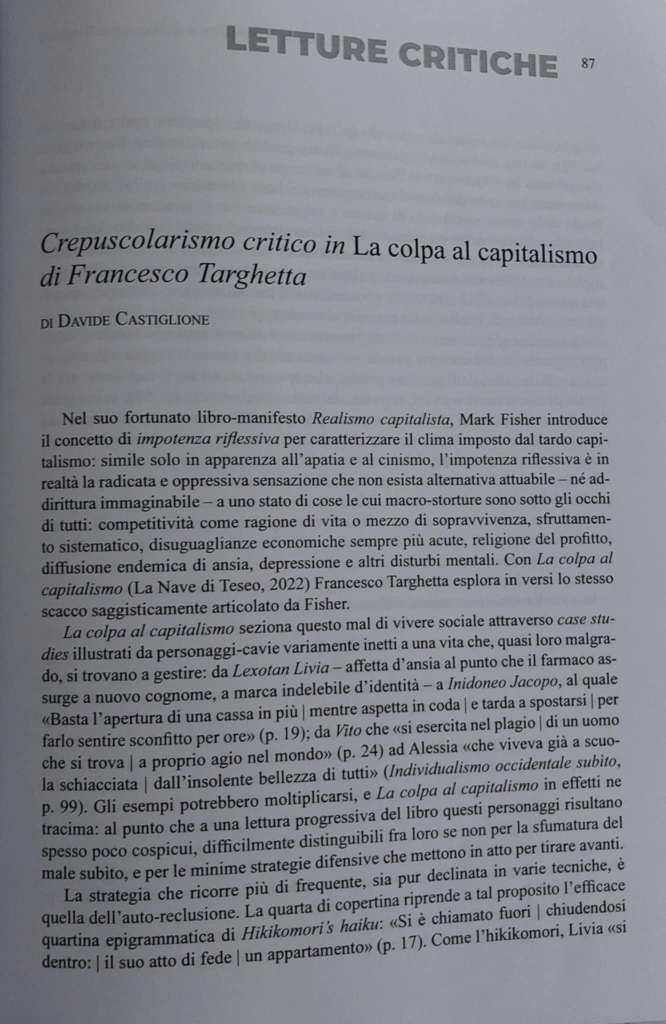
  • 29# Crepuscolarismo critico in “La colpa al capitalismo” (2022) di Francesco Targhetta. Un saggio breve.

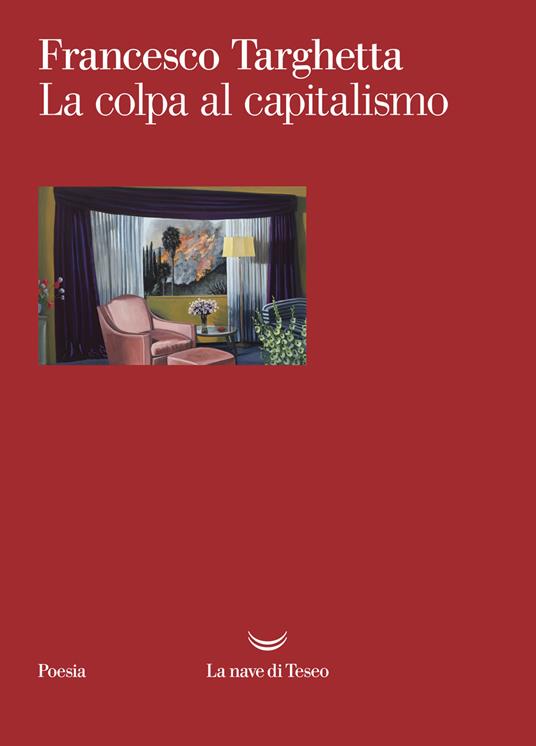
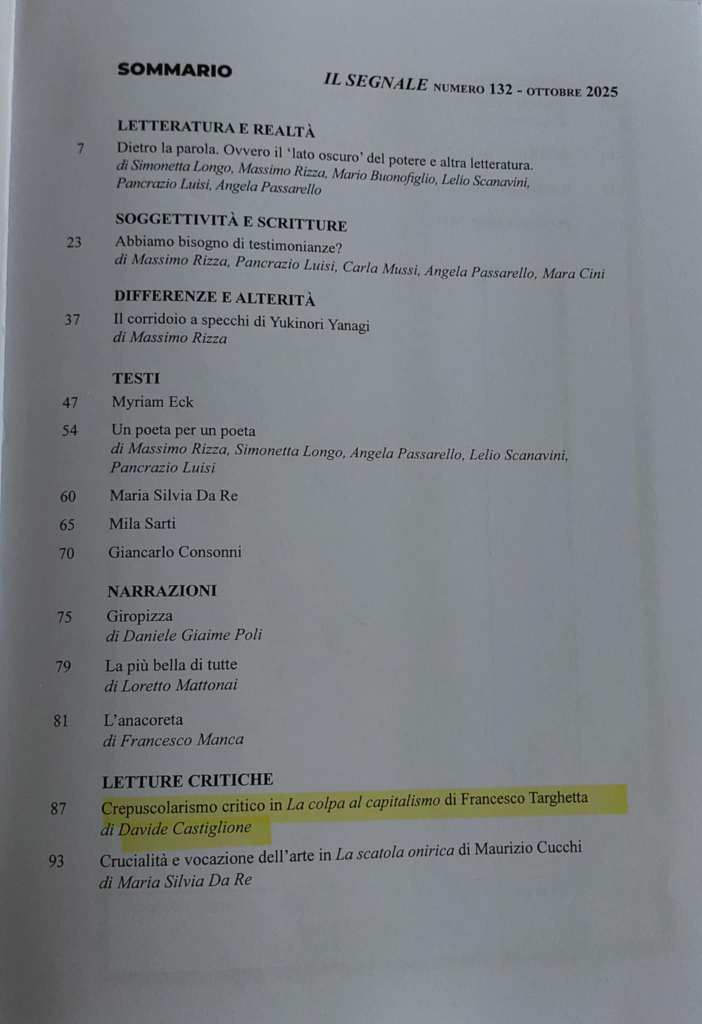
    Sul numero 132 della rivista Il Segnale (ottobre 2025, pp. 87-92) è apparsa una mia lettura critica del libro di poesie La colpa al capitalismo (La nave di Teseo, 2022) di Francesco Targhetta. Qui esamino i suoi “aneddoti narrati in terza persona” su personaggi marginali, emarginati dalle logiche competitive e per questo emblematici del mondo tardo capitalista. Commento anche la sua vena narrativa, talvolta più fluviale e talaltra più epigrammatico-ironica, e sottolineo i motivi d’interesse e anche d’importanza di questo libro; ma non taccio della qualità disuguale dei testi e della loro ipertrofia numerica, che porta a un senso (voluto?) di ridondanza e saturazione.

    Propongo qui, dopo l’indice, la prima pagina del saggio. Per leggere il resto, consiglio di acquistare il numero della rivista, o – perché no?- anche abbonarvi!

  • 28# Simone Migliazza su “Doveri di una costruzione”

    Ieri Simone Migliazza ha pubblicato sul suo blog una delle migliori recensioni uscite su Doveri di una costruzione (Industria & Letteratura 2022): un vero e proprio attraversamento saggistico che riesce a essere informativo, analitico, e al tempo stesso partecipe delle ragioni profonde del libro, sintetizzandolo prima per poi articolare l’identità di ogni singola sezione, rivelandomi alcuni aspetti prima opachi o ignoti a me stesso. Mi verrebbe da dire che Simone – anche al netto di altre recensioni sue che ho letto di libri di Daniele Bellomi e Antonio Francesco Perozzi – è altrettanto bravo critico quanto poeta (leggetelo anche su quel versante!)

    Lo ringrazio dunque di cuore, sia perché non è scontato che, a oltre tre anni dalla pubblicazione, un libro di poesia trovi ancora lettori disposti a scriverne; sia perché Simone è soffermato su alcuni aspetti che, mi pare, erano stati lasciati un po’ in ombra nei contributi precedenti. Mi riferisco soprattutto al discorso sull’eros e sulle relazioni di coppia, che nei Doveri è piuttosto forte, e che mi sembra (magari mi sbaglio!) secondario se non esiguo in molta poesia recente. Ma anche al discorso sull’autenticità, di cui porto a casa, sottoscrivendola in pieno, questa osservazione tra le altre:

    “In Castiglione, l’insistenza sull’inautentico non produce nichilismo: al contrario, tradisce un’energia propositiva, un calore, un desiderio di contatto con una dimensione più autentica. Quando tale contatto si realizza — nell’amicizia, nell’apertura empatica, nel sentimento amoroso liberato dalla recita o nell’esperienza estetica — si manifesta una sorta di gioia della condivisione, un abbandono lirico all’esistenza, raro ma possibile.”

    Per leggere la recensione nella sua interezza, questo è il link.

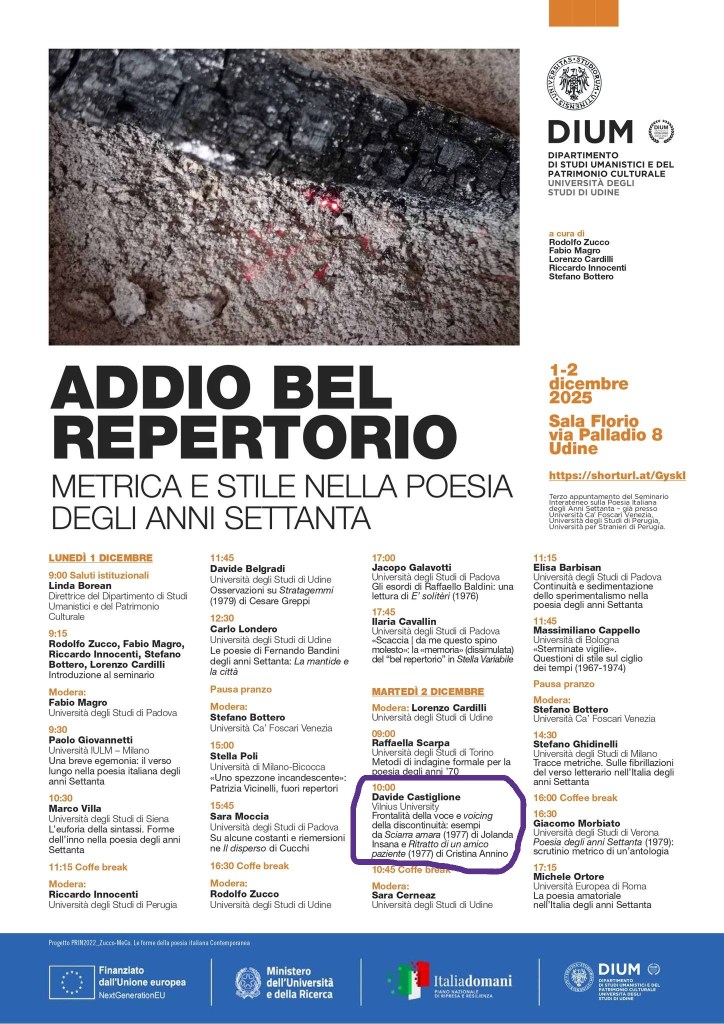
  • 25# Addio bel repertorio: metrica e stile nella poesia degli anni Settanta (Udine, 1-2 dicembre)

    Annuncio con piacere che domani torno per qualche giorno in Italia, a Udine, in occasione di un convegno su metrica e stile nella poesia italiana degli anni Settanta, insieme a molti stimati colleghi. Il mio intervento si intitolerà Frontalità della voce e voicing della discontinuità: esempi da Sciarra amara (1977) di Jolanda Insana, e Ritratto di un amico paziente (1977) di Cristina Annino. Analizzerò strategie polifoniche e di contaminazione dei registri in queste due grandi poete, e probabilmente pubblicherò sul blog il testo della mia relazione. Stay tuned!

    ps: chi vorrà potrà seguirci anche online al link – https://shorturl.at/GyskI

  • 24# A Poet, a Stylistician, a Professor: Interview with Davide Castiglione

    [A few days ago, I have been interviewed by one of my students at Vilnius University. The questions were very perceptive, touching upon my overlapping but often competing research, teaching, and poetic writing commitments. I report here part of the interview – for the full text, click on the Vilnius University (–> Faculty of Philology –> English Academy) website.]

    Professor Castiglione, a researcher in the field of English stylistics and an Italian poet, shares his secrets of balancing between multiple projects and uncovers the sources of poetic inspiration: ‘Life itself, and especially its various crises and contemporary loneliness, is the most fruitful source’.

    Dr Castiglione, the versatility of your professional interests is truly impressive. What are the biggest challenges in balancing your research and teaching activities with writing poetry? 

    Excellent question! And one I’ve often asked myself too. Doing research, teaching and writing poetry are three activities that, while rewarding in different ways, are attention-intensive and occasionally even mentally draining. Each of them requires time and serious dedication to be carried out at a satisfactory level – that is, at a level at least on a par with one’s past performance and not too far from one’s self-assessed potential. Translated into everyday lived experience, this means that two of these three areas tend to be temporarily sidelined. For example, my teaching load is much lighter in autumn than in spring, which allows me to dedicate more time to poetry writing OR research from September to January: over the last three years (2022-2025) I have experienced a prolonged creative outburst resulting in a new poetry collection that is now almost ready. This was not only a writing project, but an existential exploration of my own past and of a given historical period, roughly from the 90s to the early 00s: a memoir of sorts in which I have stayed constantly in touch with my former self and with the environment that shaped it. Regrettably, this has left me with little energy or time for academic research, which has again become my top priority (after a post-doc in 2020-2022): in August this year, I submitted a book proposal, and in 2026 I should have two academic articles coming out, which were written slowly and laboriously in 2023 and 2024. Once the poetry demon is satiated, then, the research demon is back to reclaim attention. Teaching is intensive as a performance – after all, you are leading various classes and have a responsibility in front of your students: to be knowledgeable, organised, engaging, fair. From February to May there’s almost only teaching. Luckily, preparing myself now requires less time than it used to, since I already have plenty of teaching materials I reuse every year – although, in fairness, they still require constant updating: I do not know if I am a perfectionist, but I feel less motivated when using materials that no longer satisfy me. All in all, it’s a complicated coexistence, but so far it has worked out reasonably well.

    Some projects might be more rewarding and/or exciting than others. Do you have a favorite one? 

    I have been lucky to work on projects entirely conceived and planned by myself, be they poetic, academic, or more broadly cultural. I find all of them equally exciting, each in its own right, but of course I tend to feel more strongly about the latest ones (it is only fair to say that, while I am good at starting new things, concluding them is not my forte…). For example, now there’s this new academic monograph to write, described in the book proposal mentioned before, and which itself stems from my revised stylistics course: proof of how developing new teaching materials and testing them in the classroom can provide the impetus for new research. The excitement lies in the discovery or creation process itself; the reward, however, partly hinges on how these projects will eventually be received by their intended audiences: poetic readerships, academic colleagues, institutions, the broader public. Speaking of outreach and volunteering, on 27 November I am also starting an eight-week online creative writing course for students in Gaza. This opportunity came about thanks to the support of colleagues at the University of Northumbria, UK, who already have experience in collaborating with professors and students at the Islamic University of Gaza. It is an act of solidarity made all the more urgent by the fact that education in Gaza has been systematically destroyed. 

    What motivates you to write poetry? Where do you find inspiration?

    Introspection, memory, and direct observation are the cognitive paths I walk most often when writing poetry. These paths are all rooted in silence and solitude, so inspiration often thrives in this kind of ambience (no wonder I wrote a lot during the pandemic!). Life itself, and especially its various crises and contemporary loneliness, is the most fruitful source. In my third collection, Doveri di una costruzione (Duties of a Construction), there are poems about break-ups, miscommunication, mundane epiphanies, a dog in an oncology ward, toxic masculinity, the relationship between urban places and the lives they shape, even an ekphrastic attempt at capturing live electronic concerts with their technological hymns to chaos and their primordial vibes. In short, anything that interrogates me at a certain point in life but that, unlike academic research, elicits a synthetic rather than an analytic response. Just like fiction, poetry is a kind of knowledge that is accessible via intuition and embodied experience, rather than via the careful argumentation and verifiability at the core of academic research. My ultimate motivation, however, is simply to create something that I can enjoy as a reader myself: verbal constructions with a distinctive style and a sensuous rhythm, capable of inviting (and withstanding) several re-readings. A place for someone to pause and learn or marvel, just like the church depicted in a memorable poem by Philip Larkin. [continue here]